Posts, page 2

Latest News

For all my latest news follow me on Twitter @redszell


***STOP PRESS***
Shared Vision will receive its world premiere at The Banff Mountain Film and Book Festival on Saturday 2nd November.

The 22-minute film was shot on location, edited and produced by award-winning adventure cameraman Keith Partridge, and documents my Holman Prize expedition to climb Am Buachaille, one of Britain’s most remote pinnacles.

My companions on my quest to become the first blind person to summit ‘The Tom Patey Three’ iconic Scottish sea-stacks were my climbing, wild-swimming and tandem partner Matthew Wootliff, and Nick Carter, the calmest Mountaineering Instructor in the business…

Watch the trailer here:

Click here for more info on Banff.

I am very grateful to my sponsors for sharing my vision and helping to show that blindness should be no barrier to adventure:

  • San Francisco LightHouse for the Blind who gave me the wherewithal to follow the example of James Holman ‘The Blind Traveller’.
  • Arc’teryx, Above|Below, The Castle Climbing Centre, and VauxWall, who all made sure we had the best equipment and training for a successful expedition.
  • Isokinetic Sports Injury Clinic, who ensured my full recovery when I got injured – and improved my balance!

Along with my family and friends, you have all helped me focus on what I can achieve rather than what I’ve lost – thank you!

For more information about The Holman Prize visit: http://holman.lighthouse-sf.org


Radio News – Latest

Read On is The Audiobook Show on RNIB Connect Radio. Hosted by me, it’s a blend of book news, reviews, and author interviews.

Recorded at The RNIB Talking Books Studio in London, recent highlights include interviews with all the authors short-listed for the 2019 Booker Prize, a show recorded live at The Wigtown Book Festival featuring Natalie Haynes, Alan Johnson, Lord Bird and Prof. Steve Jones, exclusive interviews with Lee Child, Joanne Ramos and Dame Stella Rimington and so much more!

Download the podcast free from your favourite provider – simply search for “Read On – The Audiobook Show” or follow the link: https://audioboom.com/channel/readonair


I am also a regular contributor to Radio 4, most recently for Annalisa is Awkward, as well as frequent appearances on In Touch both as a talking head on round table discussions and with my ‘Seeing Red’ point of view pieces on life as a blind person.

To access all the features I have recorded for In Touch, including why Aussie cricketer Shane Warne made me see red and my feature about giving back a guide dog that was included in Radio 4’s Pick of the Year 2017, click here: http://www.bbc.co.uk/search?filter=programmes&q=red+szell

Foot-Tips:

With just a fortnight to go until my Extreme Blind Triathlon style attempt on Am Buachaille I’m climbing well and feeling confident of success – Scottish weather and nesting fulmars permitting.

This is the culmination of weekly training sessions at The Castle (often under the watchful eye of our unofficial coach Dan Clemson) and a four-day expedition to the southern coast of Sardinia last month.

This expedition was a dry run for Am Buachaille.  We had planned to go to Skye but a wet and windy Atlantic weather front forced us to make alternative arrangements. 

In Sardinia Matthew and I were joined by Nick Carter of Alpha Mountaineering.  He was there with me when I summited The Old Man of Hoy in 2013 and will be our guide on Am Buachaille.  He will also belay the fourth member of our team, Keith Partridge. 

Keith is an award-winning adventure cameraman and film-maker who has worked on movies such as Touching the Void, Bonington: Mountaineer and most recently in extreme locations around The World with Steve Backshall.

In Sardinia Nick, Matthew and I were able to practice our communication on multi-pitch routes and, most importantly our rope skills at belay ledges, where three people can quickly feel like a crowd; and ropes slings and karabiners become a confusing cat’s cradle. 

As usual with climbing it’s all about having a system and sticking to it and I was glad again for Dan’s rope-work refresher sessions at The Castle.

We tried, as much as possible, to select routes that emulated the traverses, slabs and steep but juggy overhanging sections we’ll encounter on Am Buachaille.  But we stopped short of looking for a 500-metre-long rockfall causeway, strewn with seaweed, to clamber across.   Negotiating that part of the approach blind is going to be hazardous enough without tempting fate beforehand.

Something that boosted my confidence was the obvious improvement in my footwork on the rock-face.  This is due to a number of factors.  The first of which is injury. 

In seeking to build stamina for this project,  I took up running again, on a treadmill.  Although I was careful to work up slowly, I hadn’t appreciated how tight my calves and hamstrings had become, inspite of climbing!  The area behind my Achilles quickly flared up making walking down stairs agony. 

I was lucky; a sports injury clinic called Isokinetic, had heard about my project.  They provided me with expert support and weeks of intensive physiotherapy.  I not only made a full recovery but found that the mobility in my feet and ankles improved hugely.  Smearing and heel hooks became easier and the strength in my toes, and therefore my balance, was far greater.

Of all the physio exercises I was given perhaps the most effective involves putting a piece of tissue paper under your foot and scrunching it then flexing your toes and repeating 30 times for 5 repetitions on each foot, once-a-day.  It’s the foot equivalent to using a Gripmaster ball.

The second factor came with the excellent advice I received from Louis Parkinson of Catalyst Climbing.  He gave me some coaching last year after which I was climbing two grades higher!  Here are his Top 3 Tips for improving your footwork:

1: Be gentle – placing your feet onto holds as if the holds are incredibly fragile is a great way to force yourself to slow down as you approach your target, instantly improving your precision!

2: “Grab” with your feet – don’t just plonk your feet on the holds and hope they stick; your climbing shoes allow a feeling of sensitivity for good reason! It may sound like a strange tip, but I try to think of my feet as “lower hands”, grabbing holds with my toes and trying to pull them towards me as I climb…

3: This technique, which some people call “hover hands” helps improve where you place your feet.  Hover your hand over your next desired handhold for 3 seconds before grabbing. If your chosen foot position has left you unbalanced, you’ll quickly find out and learn to correct it!

 The final factor is Matthew’s constant Yorkshire refrain of ‘use yer feet lad’ and ‘keep yer bloody heels down when you smear!’  After 10 years of him being my climbing partner, I think the message might just have sunk in.

So, assuming the Scottish weather is on message, I think we’re all set for a successful ascent of Am Buachaille on midsummer’s day.

Watch this space for news…

Red Szell’s book The Blind Man of Hoy is available from The Castle Shop.

Latest News

For all my latest news follow me on Twitter @redszell


The Holman Prize – Latest

My training is almost complete and the date of my Holman Prize adventure is nearly upon us…

Project Extreme Blind Triathlon will begin on 18th June, when my climbing partner Matthew and I will board a plane to Inverness. With us, and also travelling courtesy of the generous support of easyJet, will be ‘The Beast’ (our customized mountain bike tandem).

At Inverness, we’ll be met by Nick Carter of Alpha Mountaineering who will act as our guide in The Highlands.

I’m also delighted to announce that award-winning adventure cameraman Keith Partridge will be joining us again to document our attempt on Am Buachaille – as he did with my successful ascent of The Old Man of Hoy in 2013. Let’s hope the weather and the fulmars are as benign this time as they were back then!

You can follow our progress via Twitter @redszell – meanwhile, here are some photos from our recent training climb in Sardinia:

Onwards and upwards!

For more information about The Holman Prize visit: http://holman.lighthouse-sf.org


Radio News – Latest

Read On is RNIB Connect Radio’s weekly show for book lovers everywhere. Hosted by me, it’s a blend of book news, reviews and author interviews.

Recent highlights include interviews with the 2018 Costa Award category winners, including Stuart Turton (‘The Seven Deaths of Evelyn Hardcastle’); our Christmas Special with Nigella Lawson; an exclusive chat with Sir Derek Jacobi on his 80th birthday; and conversations with Mark Billingham, Anthony Horowitz, Alexander McCall Smith, Dame Judy Dench, Dame Penelope Lively, Philip Pullman, Samuel West, Cara Hunter, The Guilty Feminist Deborah Francis White, YA author Candy Gourlay and many, many others.

And, hot off the press… don’t miss exclusive forthcoming interviews with Lee Child, Joanne Ramos and Dame Stella Rimington!

The show is broadcast every Friday at 1pm.

Simply tune into RNIB Connect Radio online, on Freeview Channel 730, or by downloading the podcast from your favourite provide including iTunes, Spotify, or AudioBoom.


I am also a regular contributor to Radio 4, most recently for Annalisa is Awkward, as well as frequent appearances on In Touch both as a talking head on round table discussions and with my ‘Seeing Red’ point of view pieces on life as a blind person.

To access all the features I have recorded for In Touch, including why Aussie cricketer Shane Warne made me see red and my feature about giving back a guide dog that was included in Radio 4’s Pick of the Year 2017, click here: http://www.bbc.co.uk/search?filter=programmes&q=red+szell

Climbing By Numbers

The question I get asked most often as a blind climber is: ‘How?!’

The glib answer, that I tend to use outdoors when I just want to get on and climb the crag, is: ‘I follow the cracks like tramlines and hope they don’t run out, or lead me into trouble.’  And for that reason I do prefer climbing good cracky rock-types like limestone and sandstone. If it’s got great friction, like gritstone, then all the better (though I get through a lot of tape sticking my fingers back together!)

Of course outdoors any feature on the route is a hold but indoors it’s a different matter.  Most walls have three or four routes set on them. Each route is set with different colour holds. And unless I’m warming up, I don’t want to rainbow the wall. I want to work through the grades and give myself a challenge.

But if you can’t see the holds (let alone which colour they are) then you can’t guide yourself. Which is where my long-suffering climbing partner, Matthew, comes in.

Over the past decade, he and I have developed a clock-face system to guide me to my next hand or foothold. Taking my chest as the centre of the clock, my right hand covers from roughly 12 o’clock to 3 o’clock; my right foot, from 3 o’clock to 6; left foot, 6 to 9; and my left hand 9 to 12 o’clock.  Obviously there is some overlap but generally it works.

So if I need to move my left foot to a higher hold that’s out to the left, Matthew will call out: ‘Left foot 7 o’clock, 12 inches.’

Depending on how hard the grade is (and particularly if the route is overhanging and I need to move through it quickly) he might add more information, such as telling me whether it’s a crimp or an undercling; or he’ll advise me to be slow and precise with my footwork if I’m toeing a nubbins or a sloper.

So a typical sequence might be: ‘Trending right: Right hand 2 o’clock, 8 inches, undercling. Right foot to 5 o’clock, 10 inches. Mantle with your left hand and rockover. Right hand to 2 o’clock, 9 inches. Match left foot to right and breathe!’

It’s not fail-safe, and as you’ll see from the video of Castle Duty Manager Dan Clemson guiding me up a 6b+ in The Tower Top-roping Area, sometimes it’s just easier to say where the hold is in relation to a part of my body. But as a general approach it works very well and means I spend a lot less time hanging around in stress positions while my guide tries to work out the next set of directions.

But it’s exhausting for my sighted guide too; both mentally, in terms of concentration and trying to put himself in my climbing head; and physically. Craning your neck to look up and shouting instructions as your blind climbing partner heads up the wall is hard work – and stressful, especially if I’m leading the route!

And as we get more tired we all make mistakes. One of the most common for every sighted guide I’ve worked with is to muddle up left and right – so my daughter and I designed a T-shirt with a large clock-face printed on the back and an L and R on the shoulders.

Another problem we’ve encountered is that as I climb higher my guides’ perspective gets foreshortened; so a hold that appears to be at 11 o’clock to him lies at 10 to me. When this happens I explore the wall with widening circles of my hand (or foot) till I find the hold.

The whole system works equally well for lead climbing, top-roping and bouldering. I have also tried a variation in which each hand or foot is the centre of its own clock face. Some coaches I’ve worked with prefer it, but Matthew and I both found it confusing and it works less well the higher I climb.

To find out, more read Red Szell’s book ‘The Blind Man of Hoy’ which is on sale at The Castle Shop.

Latest News

For all my latest news follow me on Twitter @redszell


The Holman Prize – Latest

My Holman Prize adventure is underway! You can keep up to date on how my training for Project Extreme Blind Triathlon is going by following me on Twitter.

And applications for the 2019 Holman Prize for Blind Ambition are now open. Click on the video below to meet the 2018 winners and discover how to apply.


  ‘No one should feel imprisoned by blindness’ – Red, Conchita and Stacy exploring Alcatraz


Apply for the 2019 Holman Prize and help to change the way blindness is perceived by focussing on what we can achieve rather than seeing only what we’ve lost.

My project – ‘Extreme Blind Triathlon’ – should culminate with a film of my summiting Am Buachaille in summer 2019. However, it got off to a rather rocky start in Sardinia, as you can read in ‘Epic Fail’ below.

Onwards and upwards!

For more information on The Holman Prize, and how you could apply for the 2019 competition, visit: http://holman.lighthouse-sf.org


Radio News – Latest


Read On is RNIB Connect Radio’s weekly show for book lovers everywhere. Hosted by me, it’s a blend of book news, reviews and author interviews.

Recent highlights include interviews with the 2018 Costa Award category winners, including Stuart Turton (‘The Seven Deaths of Evelyn Hardcastle’); our Christmas Special with Nigella Lawson; an exclusive chat with Sir Derek Jacobi on his 80th birthday; and conversations with Mark Billingham, Anthony Horowitz, Alexander McCall Smith, Dame Judy Dench, Dame Penelope Lively, Philip Pullman, Samuel West, Cara Hunter, The Guilty Feminist Deborah Francis White, YA author Candy Gourlay and many, many others.

The show is broadcast every Friday at 1pm.

Simply tune into RNIB Connect Radio online, on Freeview Channel 730, or by downloading the podcast from your favourite provider including iTunes, Spotify, and AudioBoom: https://audioboom.com/channel/readonair


I am also a regular contributor to Radio 4’s I**n Touch, both as a talking head on round table discussions and with my ‘Seeing Red’ point-of-view pieces on life as a blind person.

I am also a regular contributor to Radio 4, most recently for Annalisa is Awkward, as well frequent appearances on In Touch, both as a talking head on round table discussions and with my ‘Seeing Red’ point of view pieces on life as a blind person.

To access all the features I have recorded for In Touch, including why Aussie cricketer Shane Warne made me see red and my feature about giving back a guide dog that was included in Radio 4’s Pick of the Year 2017, click here: http://www.bbc.co.uk/search?filter=programmes&q=red+szell

Epic Fail

With so much emphasis on success nowadays, failure has become a dirty word.  The media in particular wants winners. Failure is not ‘inspirational’. It’s easy to forget that we learn by our mistakes. But in a rollercoaster year Matthew and I have a scarily bad day on the hill to thank for teaching us a lot about our climbing partnership.

In September I was flown out to California as a Holman Prize winner.  The award for blind adventurers will fund our attempt on Am Buachaille next year. In addition to meeting the organisers, San Francisco LightHouse For The Blind, I was invited to give a climbing lesson to a group of blind adults at Mission Cliffs. An indoor climbing centre very similar to The Castle in London where I do all my training. It was a wonderful opportunity to pass on some of the techniques and joy I have acquired over the years.

I returned to London keen to get stuck into the project that will culminate in the attempt on Am Buachaille next summer. First on the agenda: a trip to Sardinia in late October, to do a lot of planning and have a crack at another sea-stack – Pan Di Zucchero, a glorious island of white limestone, 2km offshore in Masua Bay.

However, in early September, Matthew suffered a minor stroke. Why, the doctors had no idea. His levels of health and fitness put most of us to shame.  They also ensured his full and swift recovery but he, and I, were profoundly shaken.

He was training again within six weeks and seemed stronger than ever when I fell off a bouldering problem, caught the finger of my (fortunately ring-less) ring finger behind a hold and tore the muscle in my forearm. Scarcely as serious as a stroke but hardly ideal just nine days before a challenging climb.

Despite extensive physio I had serious doubts about Pan di Zucchero.  A 130m sustained multi-pitch finishing with a 6b crux and approached by an abseil to an otherwise inaccessible ledge, it lay at the limits of my abilities even without an injury!

But Matthew was determined and climbing really well so, having aired my self-doubt, I bought a Tubigrip bandage, continued doing my physio exercises and kept the fingers of my uninjured hand crossed.  And, when we landed in Sardinia things didn’t seem so bad. We spent a couple of days warming up on some excellent single pitch routes with no ill effects from our recent medical dramas. However I’ll confess it was a relief to discover the sea was too choppy to risk the crossing to Pan di Zucchero.

Instead we decided to bag ‘Le Grand Mammut’ – a five-pitch 150m cliff climb that looks out over Masua Bay.  It’s graded 5b, 6a+, 5c+, 5c, 5c – which shouldn’t present too many difficulties…
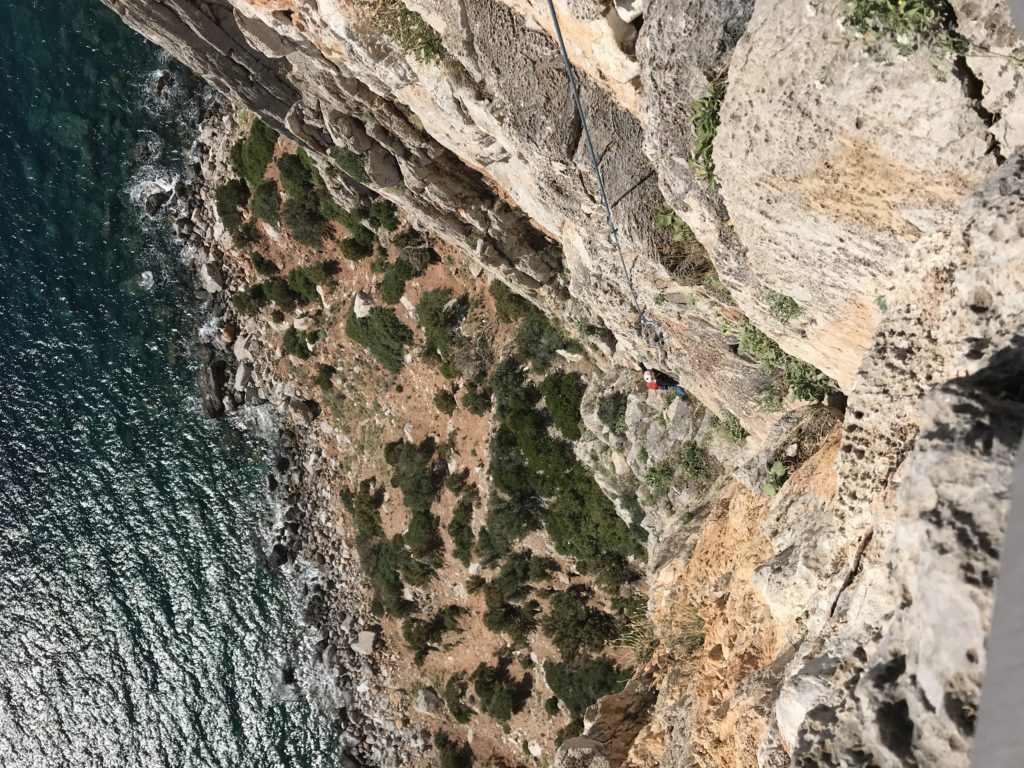
We woke early and were at the foot of the crag by 9:30, by which time it was already hot. Once you’ve got past its tricky first couple of moves – on footholds worn smooth by the attempts of others – the first pitch is fun. It ends on a narrow ledge facing out to sea – in the full glare of the sun, which by the time I got there had climbed high into a cloudless sky. As we exchanged the belay Matthew asked how my wrist was holding up.

‘Fine’ I said, swigging down water and squeezing sweat from my Tubigrip.

The second pitch is the crux and at 35m the longest of the five. As I paid out the rope I willed Matthew to finish it quickly. There was no shade on the ledge.  Sweat streamed from under my climbing helmet as if my head was being grilled. I knew I should get something over my head and drink some water but my hands were full, belaying.

‘Take!’ screamed Matthew from 20m above. As I drew in the few inches of slack the rope jerked and snapped taut by my ear. If only I could turn my back to the sun but on such a narrow ledge there would be no room to belay properly and it was too late to alter my stance. I’d just have to sweat it out.

At last Matthew shouted down that he was anchored. My head was pounding and I was beginning to feel sick. I’d been on that exposed ledge for the best part of an hour and couldn’t wait to get off.  I should have drunk some water but was worried I might drop the daypack if I took it off. Also I couldn’t wait to escape that bloody ledge.  So I unclipped my cow’s tail and began to head up. The first 15 m was a doddle and I began to feel better. Positive holds led up to a corner with a little shade and a big crack to follow.

I followed it up, only realising when I felt a tug at my harness that I’d deviated from the route and climbed above a quickdraw. I blinked away sweat from my useless eyes, swore and lay back one-handed from the corner crack to search the wall on my left for holds.  Nothing – it felt as smooth as if it had been rendered. Smearing with my left foot I bridged out far enough to brush the ‘draw with my fingers.  I leaned out further praying my foot wouldn’t slip.

Under the full glare of the sun again I felt dizzy.  I fumbled with the quickdraw. My leg started to spasm and my foot began to slide down the face of the rock.  Slick with sweat the fingers of my right hand slid from the corner crack, launching me on a pendulum beneath the quickdraw.

I cursed and yelled my apologies up to Matthew.  I was starting to appreciate just what a ballsy lead this must have been – and why it had taken him as long as it did. I called up to him again, asking whether this was where he’d fallen off.

‘Nah,’ he replied ‘It gets harder further up.’

Groaning I unclipped the ‘draw and began to work my way around the bulge above it, following the rope towards the crux.

Here my memories, like the holds, get sketchy.  The route meandered back and forth round an arête, repeatedly throwing me off balance.  My footwork, never my strong suit, went to pieces and I began to fear that all the hanging off finger pockets would tear my arm muscle again.  It throbbed in time with my head and I began to make more and more mistakes.

I whacked my head on the underside of a bulge and even as I praised the resilience of my helmet I felt my brain swimming from the impact.  Flinging my right hand up in search of a hold I tipped out round the arête, lost my footing and cut loose entirely. As I tried to pull myself up my injured arm twinged and a wave of nausea flooded through me.  I let go and hung there wondering which end my breakfast was going to reappear from.

‘Yeah, this is the crux,’ Matthew called down. ‘You’ll have to look for them but the holds are there…’  He hadn’t realised how much trouble I was in, couldn’t see me round the arête and under the bulge. I was panting hard, fighting to control my breathing and get my shit together. I gave it another minute or so then with a hoarse cry of ‘climbing!’ and, feeling strangely light-headed, started back up to where I’d fallen off.  This time I made it over the bulge but again the rock face felt like it had been rendered and whitewashed. ‘Bridge out to your right’ shouted Matthew. ‘If you don’t mind going off the route there’s a gully you can follow for a bit’.

I groped around but found only thin air.

‘No you’re right’.

What was I right about, I wondered?

‘Right, Red, Right’

Woozily I realised what he meant, I stuck out my right, correct, leg this time and found the rock face.  My left leg began to jitter like Elvis and, as I raised my arms to unclip the next quickdraw, I felt the energy drain from them. Another wave of nausea swept over me. I gulped down breaths to fight it and tasted blood as my dry lips cracked and split. I gagged and began to retch.

I was desperate not to be sick. I couldn’t afford to get anymore dehydrated. The knowledge that there was half a litre of water in my backpack was torture. I dared not try to get it, my hands were shaking too much. I had to get to the belay ledge.

I tried calling up to Matthew but only succeeded in producing slurred mumblings that did nothing to allay his worries.

‘How far away?’ I eventually managed.

’Three quickdraws.’

I moaned.  ‘I’m done. Sunstroke.’ I croaked.

There was a long silence.  I sat back on the rope and tried to focus. About 20 feet above lay shelter and water. I groped at the rock above me. It felt impossibly steep and just moving made my head spin. Matthew was trying to talk to me. I heaved my thoughts back to focus on his words.

‘Can you climb up to me?’  He sounded worried.

‘I don’t think so.  I feel sick.’

‘Shit,’ I heard him mutter. A minute or two later he called down again.  ‘We’re going to have to ab’ back down. Can you remember how to set up an abseil?’

For the first time that morning I felt cold.  My mind turned the question over painfully slowly. I wasn’t sure I could remember which foot was which at the moment. I began to work down the checklist: ‘…double rope through the ATC…’ I croaked.

‘Right’ he sounded relieved. I knew he knew this but needed to know that I did too, so he could double-check the procedure next to me.  I guess he also wanted to find out how compos mentis I was.

‘I’m going to make you safe, take you off belay and try and work this out,’ he called down. ‘Okay?’

I mumbled something incoherent even to me, and pulled myself into the rock. Once off belay I slumped into my harness and let the fuzziness I’d been fighting flow through me. I don’t know how long I hung there. Next thing I remember Matthew was calling down to me.

‘I can’t set up an abseil with you on the rope. If you can climb to the next quickdraw you can clip in and rest on the ledge below it. Do you reckon you can do that?’ An imploring note had entered his voice reminding me that we were a partnership and relied as much on each other as our own abilities. I took some deep breaths and found solid holds for my feet.

The next ‘draw was out at about 11 o’clock to me. It was only 6-or-so feet but every inch seemed like a battle. My legs and arms shook and my head and balance swam but I made it and after a few attempts clipped into the protection with my cow’s tail.  I took a long rest while Matthew busied himself with the rope. Now that I could hear him, muttering as he talked himself through what he was going to do, he seemed closer and I felt more safe and therefore more equal to the task ahead.

Again I ticked off the steps for an abseil, skills we’d rehearsed at The Castle before leaving London.  They came back quicker now, more tangible. I realised that my position twelve-feet below Matthew made the risk of mishap much greater. It would be far safer to stick to what we’d practiced and abseil from a proper belay stance. I could sense Matthew’s discomfort with the situation as it stood and so began to grope around for hand and footholds.

I was also conscious that I had been sitting in my harness for too long. My legs felt heavy and I couldn’t be sure how much my wooziness was caused by sunstroke and how much by poor circulation.

My fingers traced a ladder of square-cut footholds up the left of the wall and a flake like an elephant’s ear up the right. I could and would do this!
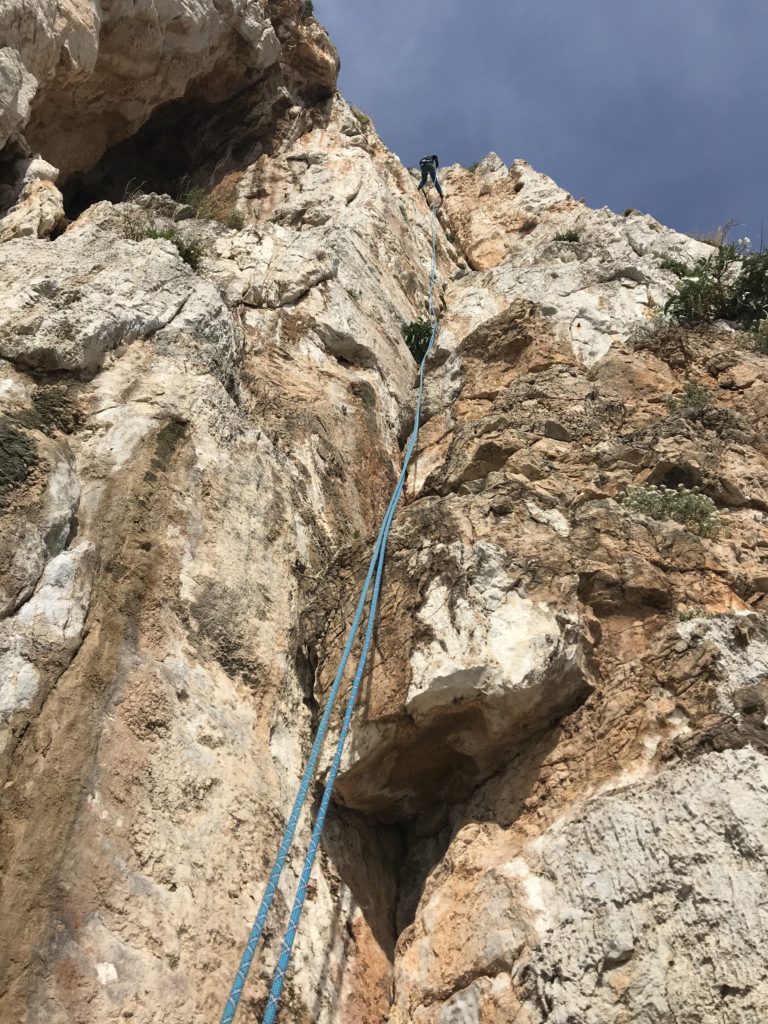
I called up to Matthew to put me back on belay.  Though he doublechecked that I felt up to it, the relief in his voice was audible. As I felt the tug of the rope at my harness I took a series of long breaths, unclipped my cow’s tail and began to climb. On any other day it would have been a beautiful finish to a hard-won pitch. The holds just seemed to appear where they were needed and soon I was flopping down next to Matthew on a narrow ledge. But I felt too much like death to appreciate anything other than that rest and rehydration were at hand.  My head pounded and when I held out my cows-tail to make myself safe it was as if I were doing it via remote control. Matthew took it from me, then quietly slid a carabiner through two half-hitches making me secure before unzipping the day-pack and feeding me small sips of water.

‘That was scary,’ he said eventually. By now I was clutching the bottle, more terrified I would drop it than by anything else.

I nodded.  ‘Sorry. I blame my Irish forebears, I just can’t take this heat, that sun.’  I wafted a hand at the fireball behind him careful not to move my head from his shadow.

He grunted. My retreating nausea was being replaced by a gnawing sense of guilt. Matthew was climbing well and we had an objective that I was proving unequal to. Against my better judgement, but knowing we had done the crux so that easier pitches lay ahead, I said quietly.

‘I could give the rest the route a go if you want to carry on.’

‘No f***ing way,’ he snapped. ‘I’ve had quite enough excitement for one day! Let’s just ab down and go for a nice cool swim.’

A wave of relief swept through me.  The cool waters of the ocean lay just 200 metres below, and I made lying in them within the hour my new objective.

With both of us now focussed on our descent Matthew set up the abseil, talking me through every step as he did it, as much to reassure himself as remind me.

Finally we were ready and, after one last check, Matthew began to lower himself down to the first belay ledge.  When I joined him there ten minutes later it was still baking in the full heat of the sun. I finished the water as I waited for Matthew to set up and ab off, wondering whether I could or should have done anything differently on my previous visit, before deciding that this probably wasn’t the best time to conduct a post mortem.

That came later, along with a fierce attack of the shivers, in the shadow of the cliffs, in a beach café, looking out over Masua Bay; when the full impact of what we had both just endured hit me.

‘I was absolutely terrified,’ Matthew confided. ‘I thought you were going to pass out and then just be hanging there so I’d have to climb down and lower you off from 60 metres.’

‘I was more afraid of being sick. I couldn’t afford to get more dehydrated. God, I’d have killed for a Camelbak! But I knew I had to keep going. I guess that’s what got me up to the belay ledge – eventually.’

‘I’m bloody glad you did. Only, by the time you decided to tell me, I’d just worked out how I could set up an emergency abseil. And I’d hauled up all that rope! I was knackered!’

‘Well sor..ree!  Next time I’ll stay put then.’

‘Let’s try not to have a next time – eh?’

Silence, then… ‘Well at least no one died,’ we said in unison.

And with that we moved on. In the context of failures it could have been much worse. If we didn’t exactly triumph over adversity, we did at least overcome it and live to fight another day.

But as both of us agreed the following Friday in the Engine Room at The Castle, we have returned wiser and in some ways more confident climbers. For my part I needed a reminder that the sport I love is more than just a physical challenge. It’s about risk analysis, problem solving and above all, partnership.  If I am honest, I think I have allowed my personal agenda of meeting and overcoming physical obstacles to blind me to the need to respect these other aspects of climbing.

Perhaps too I allow others to assume responsibility for me too easily. Indoors it’s not so much of an issue, but outdoors on a multi-pitch, it’s more important than being physically equal to the climb.

So, despite Sardinia being a bit of an epic, I am glad we failed to summit. Success should never be taken for granted and now I have a greater understanding and respect for the challenge we face as blind climber and sighted partner. All of which should stand us in better stead for our attempt on Am Buachaille next summer – where hopefully the Scottish weather will be a little cooler!
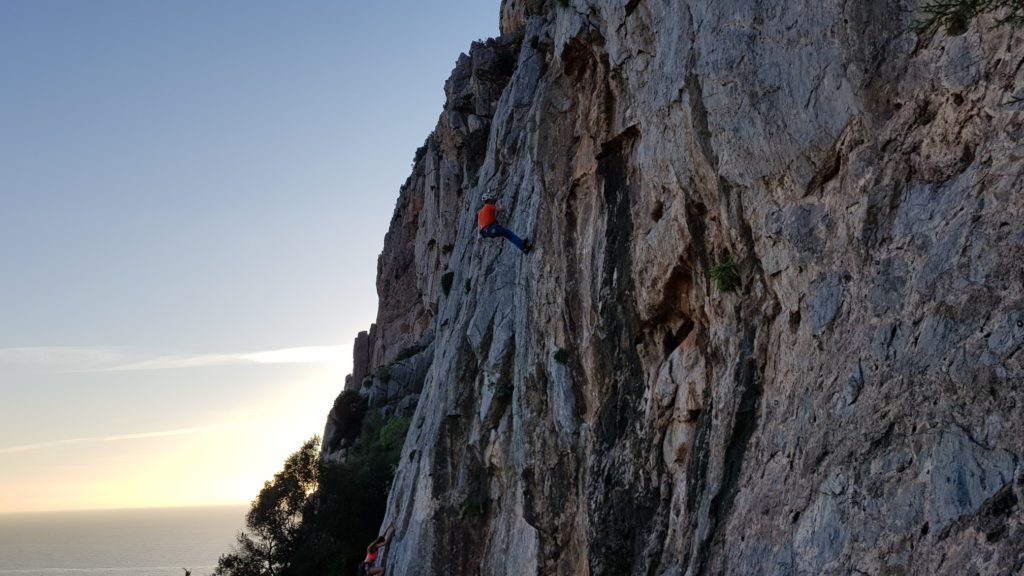

Holman Prize – Latest News

I’m just back from San Francisco Lighthouse for the Blind – the organisers of the Holman Prize. During this welcome week I met my fellow prizewinners, conducted a climbing lesson at Mission Cliffs, learned how to salsa and visited Alcatraz (see pictures below). The countdown to my Holman Prize adventure has begun… For more information visit the Holman Prize website: http://holman.lighthouse-sf.org

***STOP PRESS***

The 2018 Holman Prize

I am delighted to announce that I have been awarded this prestigious international prize for blind adventurers.

Launched in 2017 by the San Francisco LightHouse For The Blind to ‘support the emerging adventurousness and can-do spirit of blind and low vision people worldwide…the Prize provides financial backing for three individuals to explore the world and push their limits…to savor the richness of a world that is so often thought of as inaccessible to the blind.’

This year the organisers received entries from every continent on Earth (except Antarctica!) and had to whittle them down to three winners.

My project – Extreme Blind Triathlon – was one of those chosen.

And though it’s just under a year until I attempt this extreme sports triple challenge, it’s never to early to start training…

So here are some photos of me reacquainting myself with the joys of climbing on sandstone last weekend at Fontainebleu in France:

Like me, this website is about to get a lot more active, so please follow me and help spread the word. The Holman Prize is an annual award and it would be great to see it attract even more blind ambition in years to come.

For more information check out their website: http://holman.lighthouse-sf.org where you’ll also find more information about the 2018 winners.

All Party Parliamentary Group Speech – 25th April 2018

Speech made to the All Party Parliamentary Group (APPG) on Eye Health & Visual Impairment
Committee Room 4, Houses of Parliament
Wednesday 25th April 2018


Thank you for this opportunity to tell my story of being one of the 2 million people in the UK with sight loss.

Imagine opening your front door, stepping out into the new day and tripping over a low wall. It wasn’t there yesterday; and when you visit the council to have it removed you’re told that it is merely the foundation for a much taller wall that will eventually surround your home. Nothing you can do or say can prevent it, and for the next few years you watch powerless as it rises, obliterating your light and your view.

It makes going outdoors hazardous. Your work suffers; your mental health suffers; your relationships suffer. It looms over every aspect of your life and there is nothing you or anyone else can do about it. It is slow torture.

This is the prospect that greets the 250 people diagnosed with sight loss every day in the UK.

Whether it’s due to Retinitis Pigmentosa (as in my case), Macular Degeneration (that may affect some of you), or any of dozens of other eye conditions, the outlook is the same; frustration, grief and isolation, combined with increasing dependence on others, including The State, for assistance with everyday tasks.

I was 19 when I first tripped over that wall – or more accurately walked headfirst into a concrete pillar in broad daylight. Once I’d convinced my mum I wasn’t on something she arranged an appointment with an ophthalmologist who told me that I would be blind by the age of 30.

Till then I’d thought I had the world at my feet. I was at university. I loved reading, rugby, rock climbing and was revelling in my newfound independence. Discovering I’d lose it all so soon cast a shadow over my life that has only deepened and lengthened ever since.

For the last three decades I have fought to maintain my independence and my ambitions but it is an exhausting running-battle. Whenever I come to terms with my level of sight loss another degeneration adds more bricks to the wall that separates me from this beautiful and increasingly visual world.

It’s like getting to the physiotherapy stage after breaking your leg, only to have it broken again, and again, and again for the rest of your life.

Meanwhile my peers have stridden ahead, exploring a world I can no longer even see on television.

Like so many others with degenerative eye disease I struggle with depression, and yet I count myself as one of the lucky ones. I have a support network of family and friends and a job with an employer that understands the extra challenges faced by blind people in the workplace.

It’s more than most. Levels of unemployment, isolation and mental and physical health issues in the sight loss community are shockingly high. For most of us sight loss means losing much, much more besides.

I wouldn’t wish my condition on my worst enemy, far less a member of my family. But mine is a genetic disease, as yet without a cure. Until one is found it will continue to afflict generations to come. I’d prefer it stopped with me.

As we will hear, the UK is a world leader in eye research. Remarkable progress is being made on a number of fronts and the prospect of effective therapies, and maybe even cures, has never been brighter. But we also have a growing population of blind and visually impaired people. Without an increase in funding for medical research eye disease will continue to blight more and more lives – condemning others to life behind a wall of sight loss.

Thank you for listening, and keeping a chink of light and hope open in that wall.


‘He that is strucken blind cannot forget the precious treasure of his eyesight lost.’
– Shakespeare, ‘Romeo & Juliette’

Extreme Blind Triathlon

Since becoming the first blind person to climb The Old Man of Hoy in 2013, I have not been idle – and have continued to climb at every opportunity.

At home in London, I’ve had the pleasure and support of training at The Castle – the best indoor climbing centre I have ever used. And, recently I’ve been lucky enough to work with the amazing Louis Parkinson of Catalyst Climbing.  Under his guidance I have gone up a grade in a matter of weeks!

Outdoors I’ve bagged The Old Man of Stoer and various other, mostly coastal, climbs in Dorset, East and West Scotland and Sardinia. But one climb has eluded me…

Am Buachaille is one of Scotland’s ‘Big Three’ sea stacks. In fact no less a mountaineer than Hamish MacInnes describes it as ‘the most serious of the big three’’.

It’s a glorious spearhead of Torridan sandstone rising 65 metres (213 feet) vertically out of The Atlantic at the Southern tip of Sandwood Bay, in the far North-West of Scotland.

The first ascent of Am Buachaille was made in 1968 by one of my great heroes, Tom Patey, with John Cleare and Ian Clough.  Patey was something of a sea stack specialist, putting up first ascents of most of the Scottish ones worth climbing, including the others in ‘the big three’ – The Old Man of Stoer and the big brother of them all, The Old Man of Hoy.  He died in May 1970, abseiling off The Maiden, in Sutherland Bay.

The original route is graded HVS, with a 5b crux, and gets a 1-star rating. UKC also lists another four routes, ranging from a 3-star VS 4C to an E2 5b.

But the grade is not the major challenge of this project…at least not for me.  Just getting there involves a ten-mile yomp over land dotted with bogs and lochans.  Next there’s a 200-foot descent down the cliff to the toe of the headland, then ‘a short swim’ (according to UKC) of up to 30 metres depending on how low low tide is.  After that my climbing partner Matthew and I will have about 90-minutes to complete the climb and get back to shore before the tide cuts us off.  At high tide neither the swim nor a Tyrolean is an option.  And much as I like Matthew I don’t particularly fancy spending the night with him, bivvying above The Atlantic!

At this point non-climbers often ask why I want to make my life so difficult; couldn’t I find something less ‘out there’ to do?  If they think I’m mad they must regard Matthew as certifiable for encouraging and accompanying me. So why do we do it?

Well, in the case of Am Buachaille I must admit there is an element of unfinished business. Having climbeded Hoy and Stoer I want to complete the set.

However my, and Matthew’s, desire to undertake this project runs deeper than that.  It’s far more about challenging peoples’ perceptions of blindness.  If my return to climbing has taught me anything, it is to focus on what I can achieve rather than seeing only what I have lost.

Sight loss need be no barrier to adventure. But I’m not blind to the additional challenges it presents, which is why we are proposing to tackle Am Buachaille in a unique and novel way: making it an extreme blind triathlon.

Since I find the walk-in one of the most exhausting and hazardous parts of any climb (even when it’s not boggy) we plan to cover the 10 miles to the headland on a mountain bike tandem.

I’ve got one from when I and two friends rode the 100-mile length (and 10,000-feet of hill climbs) of The South Downs Way.  Practically the whole route was off-road and on the downhill stretches we reached speeds of up to 50mph.  It took two days, with my companions taking turns piloting the tandem or riding ahead to open gates and warn on-coming ramblers!

Matthew will pilot it to the cliff edge, then guide me down to and across the channel to the base of Am Buachaille.  We are both year-round wild swimmers (no wetsuits!) and take part in events like The Big Chill Swim in Lake Windermere, in February!

With the mountain biking and the swim done, we’ll merely need to complete the climb…against the clock.

That’s the plan, but so far the logistics have held us back.  Just getting our kit up there from London is a nightmare; you can’t transport a tandem on a train and there’s no airport nearby.  We couldn’t justify the time or money necessary to give us a decent chance of success.  But then my boss at RNIB Connect Radio sent me a link to The Holman Prize.

Launched in 2017 by the San Francisco LightHouse For The Blind to ‘support the emerging adventurousness and can-do spirit of blind and low vision people worldwide…the Prize provides financial backing for three individuals to explore the world and push their limits…to savor the richness of a world that is so often thought of as inaccessible to the blind.’

The Prize begins with a challenge: blind applicants must submit a first-round pitch in the form of a 90-second YouTube video. So here it is… I hope you enjoy it!

If you do like it, then please ‘like’ it on YouTube.  The video with the most YouTube ‘likes’ automatically goes through to the next round, in which semi-finalists submit a detailed written proposal.  So, feel free to forward it to your friends and family too! It could change how people see blindness.